Table of Contents
-
Step-by-step compression and firmness tests for memory foam and down pillows
-
Specialized tests for contour memory foam: support and recovery checks
-
Common pitfalls and troubleshooting your pillow tests at home
-
What your test results mean: choosing the right contour pillow for you
-
Why the conventional quick squeeze test falls short for contour memory foam pillows
-
Find your right contour memory foam pillow with SleepComfortReport
Key Takeaways
| Point | Details |
|---|---|
| Test objectively at home | Use simple tools like a ruler, kitchen scale, and plate to measure pillow loft and firmness precisely. |
| Support matters most | A pillow must keep your head and neck neutrally aligned in your usual sleep position, not just feel firm. |
| Different materials need different tests | Fold tests work for down pillows but not for contour memory foam, which requires support and recovery checks. |
| Avoid common testing errors | Measure pillows on stable surfaces and combine multiple tests before deciding to replace. |
| Use test results to choose right | Match your pillow’s loft and firmness to your sleep style for optimal neck and spine comfort. |
What you need: tools and preparation for pillow testing
Before starting any tests, gather these simple household items to ensure you get accurate pillow readings.
You don’t need a lab. You need a few things already in your kitchen and a few minutes of focused attention. The goal is to create repeatable, comparable results so you can evaluate pillow quality at home with confidence.
According to Linens Delight’s firmness testing method, a proper home pillow test requires a flat stable surface, ruler, kitchen scale, 6-inch plate, and a recording device to capture your measurements accurately. That’s it.
Here’s exactly what to have on hand:
-
A flat, hard surface. A kitchen counter or dining table works perfectly. Soft or uneven surfaces distort your loft and compression readings.
-
A ruler or tape measure. You’ll measure the pillow’s natural height, called loft, before and after compression.
-
A digital kitchen scale. Weighing the pillow gives you a baseline and helps track compression force.
-
A 6-inch plate. This applies uniform, consistent pressure during compression tests. A dinner plate is too large and creates uneven results.
-
A pen and notepad or your phone. Recording your numbers lets you compare multiple pillows side by side.
Understanding choosing pillow height before you test helps you interpret what your loft measurements actually mean for your sleep posture.
| Tool | Purpose | Household substitute |
|---|---|---|
| Flat hard surface | Accurate loft measurement | Kitchen counter or table |
| Ruler or tape measure | Measure pillow height in inches | Standard 12-inch ruler |
| Digital kitchen scale | Weigh pillow and compression force | Any food scale |
| 6-inch plate | Apply uniform compression | Small salad plate |
| Phone or notepad | Record all measurements | Notes app works fine |
Step-by-step compression and firmness tests for memory foam and down pillows
Now that you have your tools, follow this simple step-by-step method to collect reliable firmness data.
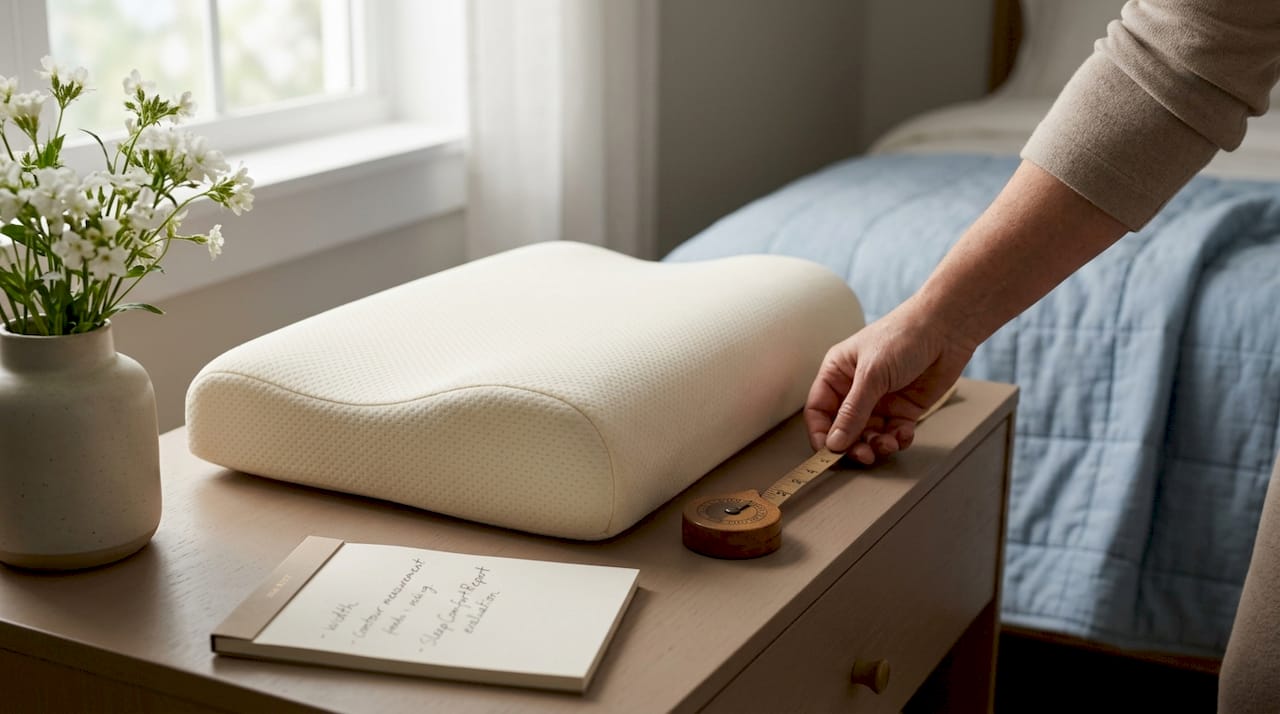 Most people judge a pillow by squeezing it in a store for three seconds. That tells you almost nothing. If your pillow feels too flat, too high, or unsupportive during the night, it may be one factor affecting your overall sleep comfort. The good news: there are practical ways to test your pillow at home and better understand its firmness, loft, and support quality. This guide walks you through simple checks, with special attention to contour memory foam pillows, which behave differently from down or fiberfill pillows.
These home pillow test techniques take about 10 minutes per pillow. If you’re comparing two or three options, work through each one in sequence and record everything before moving on.
Linens Delight’s pillow firmness guide outlines a two-point compression method covering 50% and 33% height reduction that gives you objective firmness data no squeeze test can match.
-
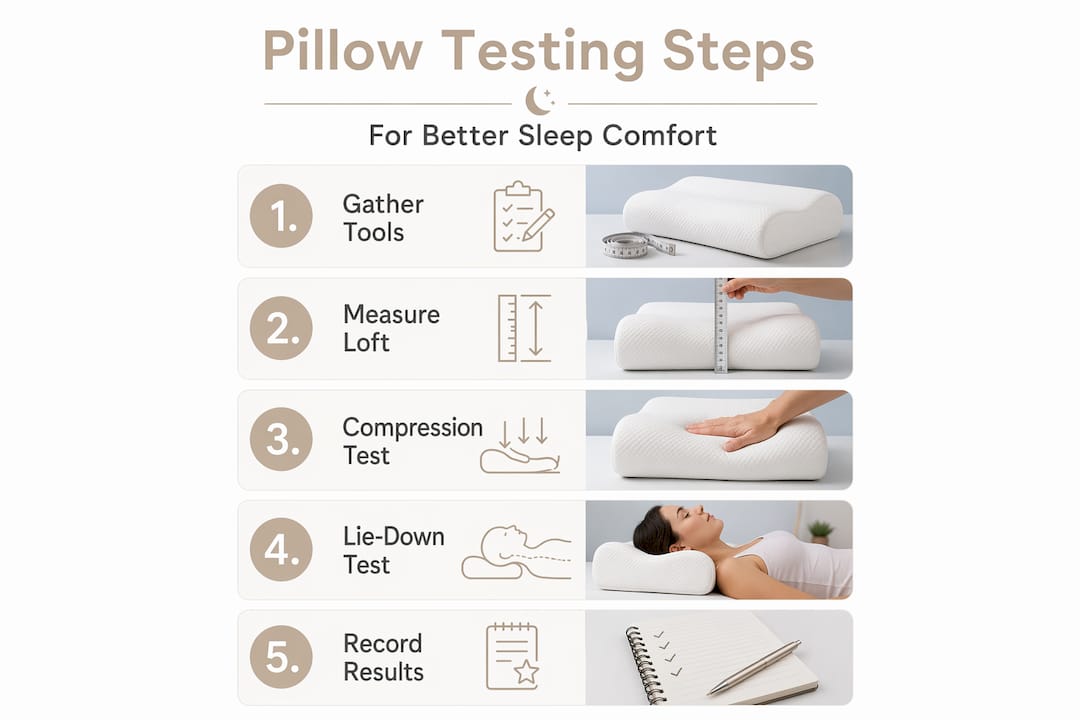
Fluff the pillow fully. Shake and reshape it so it reaches its natural, uncompressed state. This is your baseline.
-
Place it flat on your hard surface. Center it so it isn’t hanging over the edge.
-
Measure the center height. Use your ruler to measure the tallest point at the center. Write this number down. This is your natural loft.
-
Weigh the pillow. Place it on your kitchen scale and record the weight in ounces or grams.
-
Compress to 50% height. Place your 6-inch plate on the center of the pillow and press down until the pillow reaches exactly half its original height. Note how much force this requires. For a memory foam pillow, this will feel noticeably different from a down pillow.
-
Compress to 33% height. Press further to one-third of the original loft. Hold for three to five seconds, especially with foam, then release and observe recovery.
-
Record everything. Natural loft, weight, resistance at 50%, resistance at 33%, and recovery time after release.
Pro Tip: For contour memory foam pillows, measure loft at both the lower contour zone and the higher support ridge separately. These are designed to be different heights, and both measurements matter when evaluating how well the shape fits your neck and shoulder gap.
| Measurement | What it tells you | Why it matters |
|---|---|---|
| Natural loft (inches) | Pillow height before use | Determines if it fills your head-to-mattress gap |
| Weight (oz/g) | Fill density | Heavier foam often means denser, firmer support |
| Resistance at 50% | Medium firmness | Reflects support under light head pressure |
| Resistance at 33% | Deep firmness | Reflects support under full head and neck weight |
| Recovery time (seconds) | Foam responsiveness | Slow recovery may indicate aging or soft spots |
Pairing your compression data with a memory foam and latex pillow comparison helps you understand whether your current pillow’s firmness profile matches what these materials are designed to deliver.
Specialized tests for contour memory foam: support and recovery checks
With traditional firmness measures done, let’s explore tests tailored specifically to contour memory foam.
This is where most home pillow testing guides stop short. Compression numbers tell you about the material. But contour memory foam pillows are designed to perform under the specific weight and shape of your head and neck, not a plate. That distinction matters.
First, skip the fold test entirely. Fold tests don’t work for solid memory foam pillows because foam doesn’t fold or spring back the way down fill does. Applying that test to a contour foam pillow gives you meaningless results and can even mislead you into replacing a perfectly good pillow.
Instead, use these support-specific checks:
-
The lie-down support test. Place the pillow on your mattress in your usual sleeping position. Lie down for two to three minutes. Notice whether your head sinks until your ear nearly touches the mattress, or whether it sits too elevated. Either extreme signals a mismatch. A well-fitted contour pillow keeps your head and neck in a neutral line with your spine.
-
The neck gap check. While lying on your side, have someone look at the space between your neck and the pillow. There should be no visible gap, and your neck should not be bent upward or downward.
-
The recovery press test. Press your fist firmly into the foam for five full seconds, then remove it. Memory foam recovery timing tells you a lot: healthy foam should return to shape within two to four seconds. If it takes longer or leaves a permanent impression, the foam has degraded.
-
Soft spot scan. Press across the entire surface of the pillow in a grid pattern. Contour pillows should feel consistent within each zone. Any area that compresses dramatically faster than the rest is a soft spot and a sign of uneven support.
A contour memory foam pillow that passes the compression test but fails the lie-down support test is still the wrong pillow for you. Numbers are a starting point. Real-world feel under actual head and neck pressure is the final word.
Pro Tip: Test the pillow on your own mattress, not on a hard floor. A firmer mattress surface changes how the foam responds. The same pillow can feel completely different depending on what’s beneath it.
For more on side sleeper contour pillow tips and how contour shape affects shoulder clearance, SleepComfortReport has a dedicated guide. If you’re comparing cervical options, the cervical pillow support guidance covers zoned support in more detail.
Common pitfalls and troubleshooting your pillow tests at home
After performing tests, here’s how to avoid common errors and interpret your pillow’s true condition.
Home testing is only as reliable as the method. A few small mistakes can send you in the wrong direction entirely.
-
Don’t test on a soft surface. A bed or couch absorbs compression force and inflates your loft readings. Always use a hard, flat counter.
-
Don’t rely on one test alone. A pillow that compresses well but fails the lie-down support test is still a problem. Combine firmness data with real-position comfort checks for a complete picture.
-
Check for hygiene red flags. A musty smell, visible yellowing, or fill that has clumped into hard lumps are signs that no amount of support testing can fix. Combined hygiene and support failures are a clear signal that replacement is overdue.
-
Repeat your measurements. Foam can behave differently depending on room temperature. Cold foam feels firmer. Run your compression test twice and average the results.
-
Don’t rush foam recovery timing. Give the foam a full 10 seconds after each compression before measuring recovery. Rushing this step makes slow-recovery foam look healthier than it is.
Pro Tip: If you wake with neck stiffness that fades within an hour of getting up, that pattern often points to pillow support issues rather than mattress problems. It’s worth running the full support test before assuming your mattress is the cause.
For readers dealing with persistent neck discomfort from their current pillow, the neck comfort improvement guide covers support factors in detail. And if your pillow has gone noticeably flat, the flat pillow problem insights page explains what’s happening inside the fill.
What your test results mean: choosing the right contour pillow for you
With clear test results, you can now select a contour memory foam pillow tailored to your best sleep posture and comfort.
Numbers without context don’t help. Here’s how to read what you’ve recorded and translate it into a smarter pillow choice.
-
Loft too low for your sleep position? Side sleepers generally need a higher loft (4 to 6 inches) to fill the gap between the head and mattress. Back sleepers typically do better with a medium loft (3 to 4 inches). If your current pillow measures below these ranges after fluffing, it’s undersupporting you.
-
Compression resistance too soft at 33%? If the pillow compresses to one-third its height with minimal resistance, it won’t hold your head in position through the night. Look for a denser foam option.
-
Compression resistance too firm at 50%? If the pillow barely moves under moderate pressure, it may be pushing your head upward and creating tension in your neck. A medium-firm contour foam with zoned support often balances this better than a uniformly stiff pillow.
-
Contour shape vs. flat shape. Loft and compression measurements help you decide if a flat pillow’s uniform height is working for you or if a contoured shape with a lower center and raised edges would better cradle your head and neck.
-
Material matters. Memory foam conforms slowly and holds position. Latex responds faster and has more natural bounce. Your compression and recovery data tells you which behavior your current pillow has, and whether that matches your preference.
Use your recorded findings alongside a memory foam versus latex pillows comparison to narrow your choices before spending money. The pillows loft and height guide gives you the full breakdown of how to match loft to your body frame and mattress firmness.
Why the conventional quick squeeze test falls short for contour memory foam pillows
Here’s an uncomfortable truth most pillow guides won’t tell you: the squeeze test you’ve been doing your whole life is essentially useless for evaluating contour memory foam.
When you squeeze a pillow in a store or at home, you’re measuring resilience, meaning how quickly and forcefully the material pushes back against your hand. That’s a relevant quality for a down pillow. It tells you almost nothing about whether a contour memory foam pillow will actually support your head and neck through the night.
Memory foam is engineered to respond to sustained pressure and body heat, not a quick hand squeeze. A pillow that feels surprisingly firm in a three-second squeeze can still allow your head to sink too deep once you’re lying on it for 20 minutes. The reverse is also true. A pillow that feels soft to the touch may provide excellent zoned support once it warms to your body temperature and distributes weight properly.
Separating resilience from real support is the key to making a smart pillow decision, especially for adults comparing contour options. The multi-step compression test combined with the lie-down support check gives you a much more accurate picture of how a pillow will actually perform.
There’s also a financial argument here. Replacing a pillow based on a failed squeeze test, when the real issue is a mismatch in loft or shape, means you could end up with a new pillow that has the same problem. Running the full set of tests first, including the flat pillow test comparison, helps you identify whether you need a different firmness, a different shape, or simply a different material altogether.
Find the right contour memory foam pillow with SleepComfortReport
Testing your pillow at home is the first step. When you are ready to compare contour pillow options, SleepComfortReport can help you review comfort, support, materials, and buying factors before making a decision.
Our editorial guides are built specifically for adults comparing contour memory foam options, not generic buying advice. Explore our reviews of the best cervical pillows tested for neck support and zoned comfort. Learn how to care for what you buy with our contour pillow care tips to extend the life of your investment. Use the pillow loft and height guide to match your exact sleep posture and frame before you commit. And if you’re still deciding between materials, our memory foam vs latex pillows comparison breaks down cooling, support, and durability side by side. Check today’s offer and upgrade your sleep setup with confidence.
Frequently asked questions
What tools do I need to test my pillow’s firmness at home?
You need a flat hard surface, a ruler, a digital kitchen scale, a 6-inch plate to apply weight, and something to record your measurements. Linens Delight’s testing method confirms these five items are all you need for a reliable at-home firmness assessment.
Can I use the fold test on a memory foam pillow?
No. Fold tests don’t apply to solid foam because memory foam doesn’t behave like down or fiberfill. Use the lie-down support test instead, checking whether your head and neck stay neutrally aligned when you’re in your actual sleep position.
How do I know if my pillow is providing proper support?
Lie in your usual sleep position and check whether your head stays level with your spine, not sinking toward the mattress or tilting upward. The support test for neutral alignment is the most reliable way to evaluate this at home.
What signs indicate I should replace my pillow?
Replace it when it fails the support test, your head sinks to near-mattress level, you notice a persistent odor after washing, fill has clumped visibly, or you wake with neck stiffness that clears up within an hour. Multiple combined failure signs are a stronger indicator than any single test result.
Can I wash my memory foam pillow at home?
No. Memory foam should never go in a washing machine because the agitation and moisture break down the foam’s internal structure. Follow the manufacturer’s care instructions and spot-clean the foam itself while washing the removable cover separately.