
Table of Contents
-
Flat pillow use cases for stomach sleepers: when less is best
-
Comparing flat pillows and contour pillows: features and support
-
When to choose a flat pillow: practical recommendations for U.S. adults aged 45 to 65
-
Rethinking flat pillows: practical wisdom beyond conventional advice
-
Explore our premium contour and flat pillow options for better rest
Key Takeaways
| Point | Details |
|---|---|
| Loft determines support | The height of a pillow matters more than softness for proper neck and spinal alignment. |
| Flat pillows best for stomach sleepers | Stomach sleepers benefit most from very thin or no pillows to minimize neck rotation. |
| Side sleepers need higher loft | Most side sleepers require medium to high loft pillows to properly support the head and neck. |
| Mattress impacts pillow choice | Firmness and sinkage of your mattress affect the effective pillow height you need. |
| Contour pillows outperform flat | Contour pillows with a cervical roll offer better alignment support than flat pillows for most sleepers. |
Understanding pillow height and its impact on neck support
Most people shop for pillows by feel. They press down in the store, decide it feels soft or firm, and call it done. That approach misses the single most important variable: loft, which is simply how tall the pillow sits under your head.
Loft matters more than softness for keeping your neck in a neutral position. A pillow that is too high pushes your chin toward your chest. One that is too low lets your head drop, pulling the neck into extension. Both create strain over the course of a night, and that strain compounds over months and years.
Here is what loft differences mean in practice:
-
Low loft (under 3 inches): Best for stomach sleepers or very petite back sleepers
-
Medium loft (3 to 5 inches): Works for most back sleepers and smaller-framed side sleepers
-
High loft (5 inches and above): Suited for side sleepers with average to broad shoulders
Side sleepers need more loft than back sleepers because the shoulder creates a larger gap between the mattress and the head. That gap has to be filled precisely. Our pillow height guide breaks down how to measure your own shoulder-to-head distance so you are not guessing.
The right loft keeps your spine in a straight line from your tailbone to the top of your neck. It is the foundation of every other comfort feature a pillow can offer.
Understanding loft is the lens through which every flat pillow use case makes sense. With that foundation in place, we can look at each sleep position specifically.
Flat pillow use cases for stomach sleepers: when less is best
Stomach sleeping is the one position where a flat pillow genuinely earns its place. When you sleep face down, a thick pillow forces your head up and rotates your neck to one side for hours at a stretch. The result is significant cervical strain by morning.
Flat pillows are most recommended for stomach sleepers in thin or low-loft scenarios precisely because they reduce that rotation. Some stomach sleepers do best with a pillow under 2 inches. Others find that no head pillow at all is the most comfortable option.
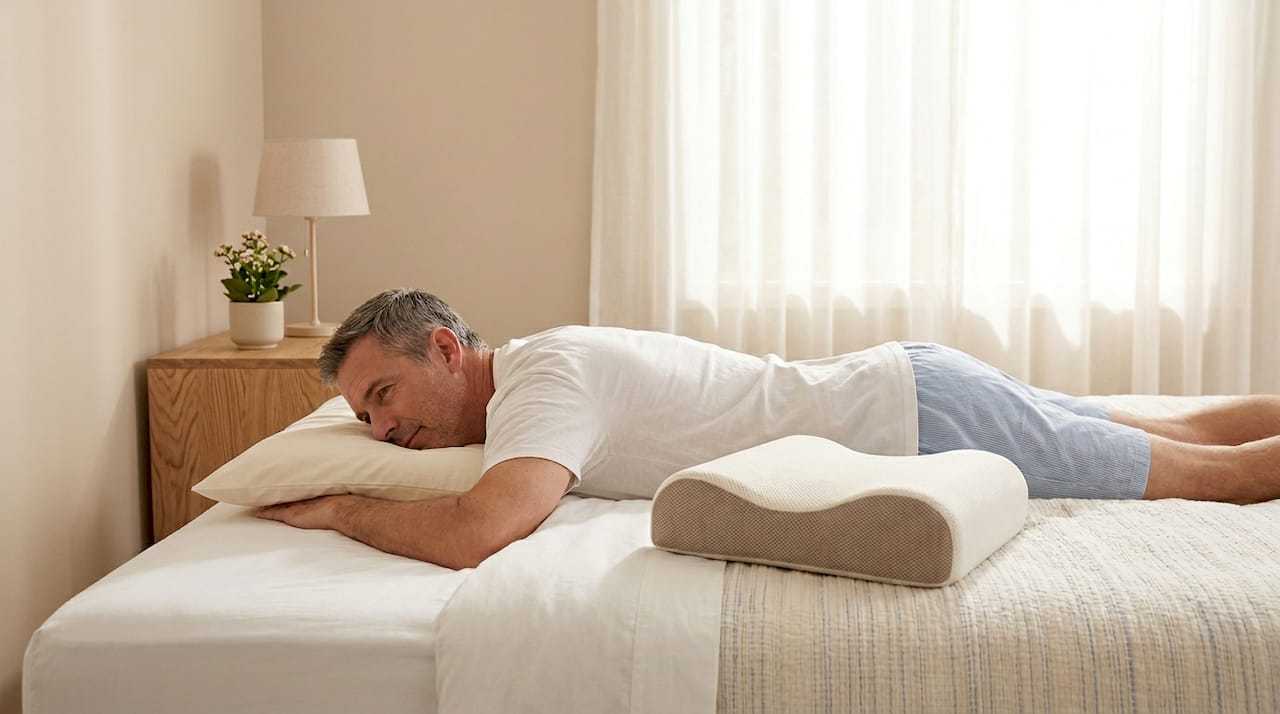
There is a second, often overlooked use for flat pillows in this position. Placing a flat pillow under the hips and pelvis improves low-back alignment by preventing the lumbar spine from arching too deeply into the mattress. This is one of the smartest uses for thin pillows that most buyers never consider.
What to look for in a flat pillow for stomach sleeping:
-
Fill material: Down, down alternative, or shredded foam compress fully and stay flat
-
Breathability: Stomach sleepers have their face close to the pillow surface, so airflow matters
-
Cover texture: Soft, smooth covers reduce friction against the face
-
Loft under 3 inches: Anything taller starts to create the neck rotation you are trying to avoid
Pro Tip: If you are a stomach sleeper who wakes with lower back tension, try placing a thin flat pillow under your hips rather than adding a thicker head pillow. The hip support often makes a bigger difference than any adjustment to head position.
The flat pillow problem becomes clear once you move away from stomach sleeping. For side sleepers especially, the math simply does not work.
Why flat pillows are usually unsuitable for side sleepers
Side sleeping is the most common position among adults, and it is also the position where flat pillows fail most visibly. The shoulder creates a gap between the mattress surface and the side of your head. That gap is typically 4 to 6 inches depending on shoulder width, mattress firmness, and body size.
Side sleepers generally need a loft of about 4 to 6 inches to prevent the head from tilting downward and straining the neck. A standard flat pillow, even a fresh one, rarely reaches that height. Once compressed under the weight of your head, it provides even less.
Side sleepers require pillows that bridge the shoulder-to-head gap properly to keep the cervical spine level. When that gap is not filled, the neck bends laterally all night. You might not feel it immediately, but the cumulative effect over weeks is real discomfort.
There are narrow exceptions worth noting:
-
Very petite frames with narrow shoulders may need less loft and could tolerate a medium-flat pillow
-
Very soft mattresses allow the shoulder to sink deeper, reducing the effective gap
-
Combination sleepers who spend only part of the night on their side may get by with a medium-loft option
For most side sleepers, a side sleeper contour pillow is a far better fit. The shaped profile fills the shoulder gap without requiring you to stack or fold a flat pillow, which is a common workaround that rarely holds through the night.
Flat pillow best use cases for back sleepers
Back sleeping sits in interesting middle ground. The gap between the mattress and the back of your head is smaller than the side-sleeping shoulder gap, but it still exists and still needs to be filled with the right amount of loft.
Optimal pillow height for back sleepers is roughly 7 to 9 centimeters, which translates to about 3 to 3.5 inches. That range supports the natural inward curve of the cervical spine without pushing the head too far forward.
Here is where flat pillows for back support become a conditional recommendation:
| Scenario | Flat pillow suitable? | Why |
|---|---|---|
| Firm mattress, average frame | Rarely | Gap too large for most flat pillows |
| Soft mattress, average frame | Sometimes | Body sinkage reduces effective gap |
| Soft mattress, petite frame | Often | Gap is naturally smaller |
| Any mattress, broad shoulders | No | Neck curve needs more support |
Contour flat pillows, which feature a low-profile ergonomic neck roll, represent a smart middle ground for back sleepers. They stay flatter than a traditional contour pillow while still providing a shaped support zone under the cervical curve. This is one of the most practical flat pillow advantages for back sleepers who want structure without height.
Pro Tip: If you are a back sleeper testing a flat pillow, lie down and have someone check whether your chin is tilting up or down. Chin up means the pillow is too low. Chin toward your chest means too high. Neutral is the goal, and it is easy to see from the side.
Our best cervical pillow 2026 guide covers contour options that work specifically for back sleepers who want low-profile support without going fully flat.
Comparing flat pillows and contour pillows: features and support
Understanding the structural differences between flat and contour pillows makes the buying decision much clearer. This is not just about shape. It is about how each pillow behaves across a full night of use.
Contour pillows with a cervical roll outperformed flat pillows in 7 of 9 studies measuring cervical alignment. That is a significant gap in performance, and it matters most for back and side sleepers who spend hours in one position.
| Feature | Flat pillow | Contour pillow |
|---|---|---|
| Loft retention overnight | Low, compresses significantly | High, maintains shape |
| Best sleep position | Stomach | Back and side |
| Cervical support | Minimal | Structured and consistent |
| Adjustment needed | Frequent | Minimal |
| Travel portability | Excellent | Moderate |
| Fill options | Down, foam, polyester | Memory foam, latex |
| Price range | Budget to mid-range | Mid-range to premium |
Flat pillows do have genuine advantages in specific contexts. They are lighter, easier to pack for travel, and more versatile for uses beyond head support, such as lumbar support while sitting or knee support while lying on your side. The flat pillow problem is not that they are poorly made. It is that they are often used in positions where they cannot physically provide what the sleeper needs.
For anyone comparing fill materials, our memory foam vs latex contour pillows guide covers how each material affects loft retention, temperature, and long-term support.
When to choose a flat pillow: practical recommendations for U.S. adults aged 45 to 65
By this point, the pattern is clear. Here is a direct, scenario-based breakdown to help you decide.
Choose a flat pillow when:
-
You sleep primarily on your stomach and need minimal cervical elevation
-
You sleep on a very soft mattress as a back sleeper with a petite frame
-
You want a secondary pillow for hip or knee support
-
You need a lightweight, packable option for travel
-
You are a combination sleeper who spends most of the night on your stomach
Avoid a flat pillow when:
-
You are a side sleeper with average or broad shoulders
-
You sleep on a firm mattress as a back sleeper
-
You wake frequently to readjust your pillow because it has gone flat
-
You have noticed neck or shoulder tension that started after switching to a lower pillow
Mattress sinkage changes the effective loft your pillow needs to provide. A flat pillow on a plush mattress functions differently than the same pillow on a firm surface, because your body sinks into the soft mattress and reduces the gap your pillow must fill.
Flat pillows often require tucking or reshaping during the night to maintain consistent support. If you are waking up to fix your pillow, that is a sign the loft is not holding through the night.
Pro Tip: Before buying any pillow, fold a bath towel to roughly your target loft height and sleep on it for two nights. If you wake up comfortable, you have a reliable loft target to shop against.
Our pillow height guide includes a measurement method that takes your mattress type into account, which makes the towel test even more precise.
Rethinking flat pillows: practical wisdom beyond conventional advice
Here is something the standard pillow advice rarely addresses: your mattress changes the entire equation, and most people never factor it in.
A flat pillow on a memory foam mattress behaves completely differently than the same pillow on an innerspring. The foam mattress allows your shoulder and torso to sink, which raises your head relative to the mattress surface. That effectively increases the loft your pillow provides. The same pillow on a firm coil mattress does the opposite. Your body stays on top of the surface, and the flat pillow suddenly feels even flatter.
This is why two people with the same pillow can have completely different experiences. It is also why buying a pillow based on reviews alone, without knowing the reviewer’s mattress type, is unreliable.
The second thing most buyers overlook is position shifting. Very few people stay in one position all night. If you fall asleep on your back but shift to your side by 3 a.m., a flat pillow that worked for back sleeping will leave you under-supported for the rest of the night. Adjustable or dual-loft pillows exist precisely for this reason, and they are worth considering if you know you move around.
The smartest approach is to measure your shoulder-to-head gap while lying in your primary sleep position, then test pillow loft dynamically rather than just pressing down with your hand in a store. Your neck comfort tips and mattress type together define your real loft target. Flat pillows are not bad. They are just specific tools that work well in specific conditions, and knowing those conditions is the entire game.
Explore our premium contour and flat pillow options for better rest
Now that you know the flat pillow best use cases and where flat pillows fall short, the next step is finding the right option for your specific sleep position and mattress setup.
SleepComfortReport has curated guides and comparisons built specifically for adults who want to stop guessing and start sleeping better. Whether you need a low-profile flat pillow for stomach sleeping or a structured contour option for back and side support, our best cervical pillow 2026 guide gives you a clear, position-specific starting point. If you are still working out your ideal loft, the pillow height guide walks you through the measurement process step by step. And if your current flat pillow is already letting you down, the flat pillow problem page explains exactly what to look for instead.
Frequently asked questions
Are flat pillows good for side sleepers?
Flat pillows are generally not recommended for side sleepers because they lack the height needed to fill the shoulder-to-head gap, which can lead to neck strain. Side sleepers typically need a loft of 4 to 6 inches for proper alignment.
Can stomach sleepers benefit from using no pillow at all?
Yes, many stomach sleepers find that skipping a head pillow entirely reduces neck rotation and improves spinal alignment. Some stomach sleepers achieve the best alignment with no pillow at all, especially on softer mattress surfaces.
How does mattress firmness affect flat pillow suitability?
Mattress firmness changes how much your body sinks, which directly affects the gap your pillow needs to fill. On a soft mattress, a lower loft works; on a firm mattress, you need more height to maintain proper cervical alignment.
What are the main disadvantages of flat pillows?
Flat pillows compress and lose loft overnight, often requiring adjustment to stay supportive. Flat pillows frequently need reshaping during the night, and they rarely provide enough support for side or back sleepers on firm mattresses.